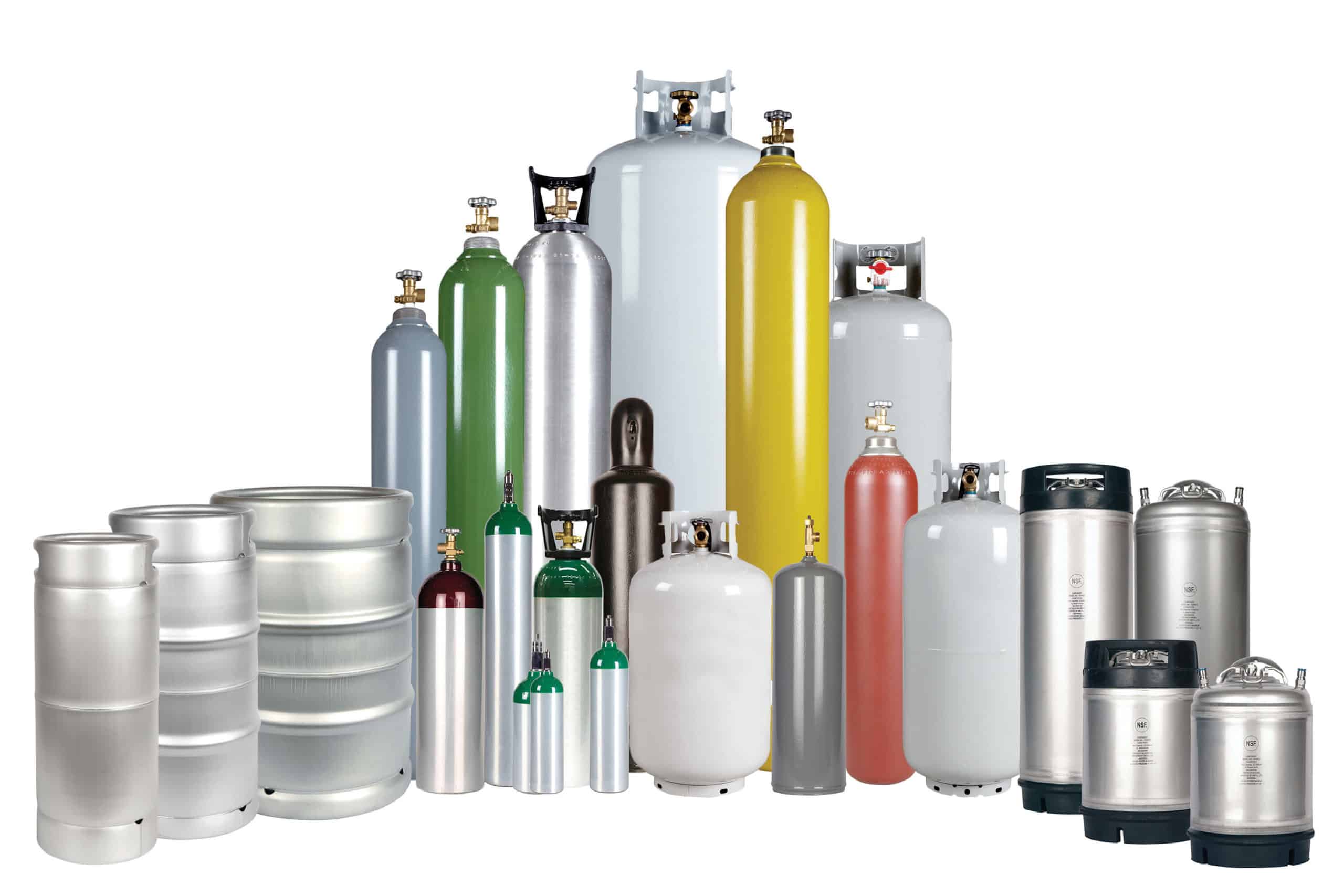
What Is Stamped on a Cylinder, and Why It Is There.
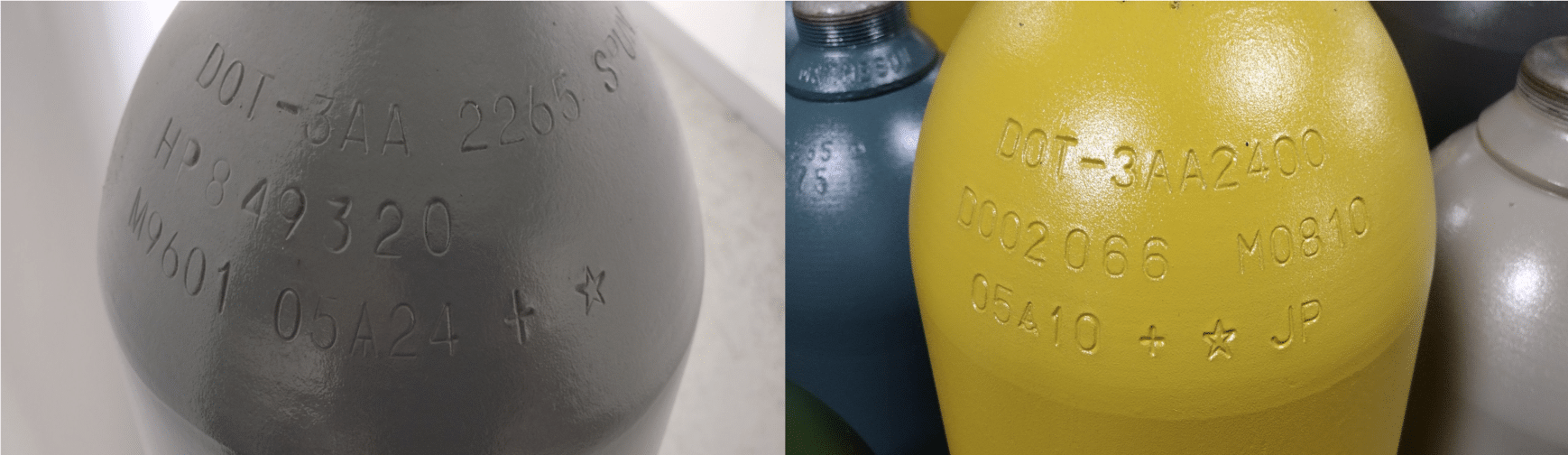
Every compressed gas cylinder in U.S. service carries a set of permanent stamps on its shoulder or crown. Those marks are not administrative labels. They are the legal record of what the cylinder is, what pressure it was built to hold, who made it, and whether it has passed the requalification tests required to keep it in service. Under 49 CFR 178.35, every DOT specification cylinder must be plainly and permanently marked on the metal of the cylinder as permitted by its applicable specification. Marking on the sidewall is prohibited unless the specification expressly allows it.
The practical consequence: if a cylinder cannot be identified from its shoulder stamps, it cannot legally be filled or offered for transportation.
This guide decodes those marks in the order they physically appear, starting with the specification designation and working through to the most recent requalification date. It covers:
- DOT and UN designation prefixes
- Specification codes, including 3AA, 3AL, 4BA, 4BW, 4E, and SP/E numbers
- Service pressure, serial number, and manufacturer identification
- Original test date and subsequent requalification marks
- The plus sign and the star, and what each one actually authorizes
- ISO and UN cylinder marking differences
- What to do when marks are illegible, missing, or contradictory
For questions about valve outlet connections and CGA fittings, see the companion CGA valve outlet connections guide. Requalification intervals and testing methods are covered in the follow-on requalification article. This piece focuses on reading what is already stamped on the cylinder in front of you.
The Decode: Reading Marks in Physical Order
DOT cylinder marks appear on the shoulder in a standardized sequence. Reading them left to right, top to bottom, gives you the complete compliance picture without having to search the cylinder for individual elements.
1. Specification Designation (the “DOT” prefix)
The first mark is the regulatory designation, typically “DOT” followed by the specification code, for example DOT 3AA or DOT 4BA. This tells you which set of manufacturing, material, and testing requirements the cylinder was built to meet. Cylinders manufactured to Canadian Transport Canada standards carry a “TC” prefix instead of “DOT.” Cylinders built to UN/ISO standards carry a different marking format entirely, covered in the ISO and UN section below.
Older cylinders may show an “ICC” prefix, reflecting the former Interstate Commerce Commission standards that preceded DOT. ICC-marked cylinders remain in service under the applicable DOT specification rules.
2. Service Pressure
Immediately following the specification code is the service pressure in pounds per square inch (PSI). This is the maximum pressure at which the cylinder is authorized to be filled under normal conditions. It is not a burst pressure or a test pressure; it is the operating ceiling stamped by the manufacturer.
3. Serial Number
The manufacturer’s serial number follows the service pressure. It is the primary identifier for traceability and record-keeping. Under 49 CFR 180.215, requalification records must include the cylinder’s registered symbol and serial number, so this mark is the link between the physical cylinder and its maintenance history.
4. Manufacturer Symbol or M-Number
The manufacturer’s registered symbol or PHMSA-issued M-number identifies who built the cylinder. This mark matters when cylinder-specific data, such as rejection elastic expansion (REE) values for plus-sign evaluations, must be sourced from the original manufacturer.
5. Original Test Date
The original hydrostatic test date is stamped as month and year (for example, 06 24 for June 2024). This is the starting point for calculating the requalification due date. It is distinct from the date of manufacture, which may precede the first test date by weeks or months during production.
6. Requalifier RIN and Subsequent Dates
After the first requalification, the cylinder carries additional date stamps. Each requalification mark follows the format: month, RIN (four characters arranged in a square pattern at the center of the date grouping, per 49 CFR 180.213), then year. The RIN identifies the DOT-registered facility that performed the test. A cylinder with multiple requalification events will show multiple date-and-RIN groupings. The most recent grouping governs compliance status.
Key rule: under 49 CFR 180.213, the RIN characters must be at least 3.18 mm (1/8 in.) high and arranged in a square pattern, with the first character at upper left, second at upper right, third at lower right, and fourth at lower left, bracketed by the month and year of the test.
Spec Code Decoder Table
The alphanumeric code that follows “DOT” on the shoulder is the specification designation. It tells you the material, construction method, and pressure class of the cylinder. The table below covers the codes most commonly encountered in industrial, welding, beverage, and life-safety applications.
| Spec Code | Material | Typical Use | Notes |
|---|---|---|---|
| 3A | Steel | High-pressure industrial gas | Predecessor to 3AA; still in service |
| 3AA | Steel | High-pressure industrial, welding, breathing air | Most common high-pressure steel spec; 5-year base requalification interval under 49 CFR 180.209 |
| 3AL | Aluminum | Medical oxygen, SCBA, beverage CO2 | 5-year base interval; aluminum alloy 6351-T6 cylinders in SCBA/SCUBA or oxygen service require additional SLC inspection per 49 CFR 180.209 |
| 4BA | Steel | Propane, refrigerant, low-pressure gas | Welded steel; service pressure stamped on shoulder |
| 4BW | Steel | Propane, refrigerant | Welded steel with longitudinal seam; similar service profile to 4BA |
| 4E | Aluminum | Propane, refrigerant | Welded aluminum; less common in industrial service |
Special Permit (SP) and Exemption (E) Numbers
Some cylinders carry an “SP” or “E” number in addition to, or in place of, a standard spec code. These indicate that the cylinder was manufactured or is being used under a DOT Special Permit (formerly called an Exemption). The SP or E number is the authorization reference. It does not replace the need for proper requalification; the permit itself specifies the applicable test intervals and methods. If you encounter an SP or E number on a cylinder and need to verify the current terms of the permit, the PHMSA Special Permits database is the authoritative source.
Operational note: the spec code also determines the minimum hydrostatic test pressure. For 3AA cylinders, the test pressure is 5/3 times the service pressure, per 49 CFR 178.37. For 4BA and 4BW cylinders with service pressure below 500 PSI, it is 2 times the service pressure, per 49 CFR 178.51 and 178.55 respectively. These test pressures are set by the specification, not by the requalifier.
Reading the Date and Deciding Whether the Cylinder Is in Date
The test date stamped on a DOT cylinder is expressed as month and year. The most recent date on the shoulder, whether the original manufacturer’s test date or the most recent requalification date, is the one that governs compliance. Count forward from that date to determine when the next requalification is due.
Base Intervals Under 49 CFR 180.209
The requalification interval depends on the cylinder’s specification and service history:
- 3AA, 3A: 5 years as the base interval; 10 years is available under specific conditions (see the star, below); 12 years is available under 49 CFR 180.209(j) (water-jacket method) and 180.209(h) (direct expansion method)
- 3AL: 5 years as the base interval; 12 years under 49 CFR 180.209(j) and 180.209(m)
- 4BA, 4BW: 5 years as the base interval; 7, 10, or 12 years under specific conditions per 49 CFR 180.209(e), (f), and (j)
The interval is determined by the specification and conditions of use, not by the requalifier’s preference or the owner’s schedule.
Worked Examples
Example 1: Standard 5-year DOT 3AA cylinder Shoulder reads: DOT 3AA 2015 / SN 12345 / MFR SYMBOL / 06 24 The most recent test date is June 2024. The base interval for 3AA is 5 years. Next requalification is due by June 2029. No star is present, so the 10-year extended interval does not apply.
Example 2: Cylinder with multiple requalification dates Shoulder reads: DOT 3AA 2015 / SN 67890 / MFR SYMBOL / 04 14 / 05 [RIN] 19 / 06 [RIN] 24 Three test dates appear. The most recent is June 2024. That is the date from which the next interval is calculated. Earlier dates are historical record only.
Example 3: 4BA propane cylinder Shoulder reads: DOT 4BA 240 / SN 11111 / MFR SYMBOL / 03 18 Service pressure is 240 PSI. Most recent test date is March 2018. Base interval for 4BA is 5 years. This cylinder was due for requalification by March 2023. It should not be filled until requalified.
A cylinder whose requalification date has passed is out of service for filling and transportation purposes. The decision to fill or not fill rests on the most recent stamped date, not on a label, a tag, or a verbal representation.
The Plus Sign and the Star
Two symbols can appear alongside or after a test date and change what the cylinder is authorized to do. Both are commonly misread. Neither is a general endorsement of cylinder condition.
The Plus Sign (+)
A plus sign stamped after the most recent test date indicates that the cylinder has met the elastic expansion criteria in 49 CFR 173.302a(b) and is authorized to be filled with a Division 2.2 non-flammable, non-liquefied gas to 10 percent above its marked service pressure. The initial plus sign is typically applied by the manufacturer. A requalifier may apply subsequent plus signs, provided the water-jacket hydrostatic test has been performed and the cylinder’s average and maximum wall stress remain within the limits of 49 CFR 173.302a(b)(3).
What the plus sign does not mean: it does not extend the requalification interval, it does not apply to liquefied gases or flammable gases, and only the plus sign following the most recent test date governs. Earlier plus signs on the same shoulder have no current authority.
The Star (Five-Pointed)
A five-pointed star stamped immediately after a test date indicates that the cylinder qualifies for a 10-year requalification interval instead of the standard 5-year interval, under the conditions of 49 CFR 180.209(b). To carry the star, a DOT 3AA cylinder must meet all of the following:
- Water capacity of 125 lb (56.7 kg) or less
- Removed from any cluster, bank, group, rack, or vehicle each time it is filled
- Used exclusively for specific non-corrosive, non-flammable gases listed in 49 CFR 180.209(b)(1)(ii)
- Not used for underwater breathing
What the star does not mean: it does not grant indefinite service life, it does not apply to 3AL cylinders, and if the cylinder is subsequently filled with a gas outside the approved list, the star must be obliterated and the 5-year interval resumes from the most recent test date.
ISO and UN Cylinder Markings
A cylinder built to UN/ISO standards reads differently from a DOT cylinder. Recognizing the difference matters because the filling rules, pressure designations, and requalification terminology are not identical, and treating a UN/ISO cylinder as a DOT cylinder, or vice versa, creates compliance risk.
How a UN/ISO Cylinder Is Marked
UN/ISO pressure receptacles carry markings governed by 49 CFR 178.71 rather than 49 CFR 178.35. The marking structure is organized in three rows:
- Top row (manufacturing marks): inlet thread profile, country of manufacture, manufacturer’s serial number
- Middle row (operational marks): test pressure (PH) in bar and PSI, service pressure (PW) in bar and PSI, tare weight, minimum guaranteed wall thickness
- Bottom row (certification marks): UN packaging symbol, ISO standard used for design and testing (e.g., ISO 9809-1), country of approval (USA for cylinders approved under 49 CFR)
Key Differences from DOT Cylinder Markings
| Element | DOT Cylinder | UN/ISO Cylinder |
|---|---|---|
| Pressure designation | Service pressure in PSI only | Both PH (test) and PW (service) in bar and PSI |
| Date format | Month-year (e.g., 06 24) | Year then month (e.g., 2024/06) |
| Thread profile stamped | Not required | Required |
| Plus sign / star | Applicable | Not used; service pressure already accounts for higher fill levels |
| Requalification term | Requalification | Periodic inspection and testing |
“Mapped” Does Not Mean Interchangeable
DOT and UN/ISO cylinders of the same physical dimensions and valve compatibility are not operationally interchangeable without verifying the applicable filling rules. A UN/ISO cylinder approved for U.S. service must carry “USA” as its country-of-approval mark per 49 CFR 171.12(a)(4). A cylinder marked “CAN” is approved for Canadian service and may also be used in the U.S. under mutual recognition provisions, but the applicable filling limits are those of the UN/ISO standard, not the DOT specification.
For a side-by-side summary of DOT and ISO/UN cylinder specifications, All Safe Global’s ISO vs. DOT Cylinder Summary is available as a downloadable reference. For valve outlet connection compatibility across DOT and UN/ISO cylinders, see the CGA fittings chart.
When the Stamps Are Illegible, Missing, or Contradictory
This is the section most guides skip. It is also the situation most likely to create liability for the operator, the fill station, and the facility.
Illegible Markings
Under 49 CFR 180.213, requalification and specification markings must be legible so as to be readily visible at all times. A marking that cannot be read is not a compliant marking. Corrosion, over-painting, physical damage to the shoulder, or stamps that were applied too lightly can all produce illegible marks.
The practical rule: if you cannot read the specification designation, the service pressure, or the most recent test date, the cylinder cannot be confirmed as in-date or properly specified. It should not be filled until the marking situation is resolved.
Resolving illegible markings is not a field operation. It requires the cylinder to be taken out of service and sent to a DOT-authorized requalification facility. The facility can inspect the cylinder, attempt to recover the markings, and, where warranted, requalify and re-stamp the cylinder. A facility cannot simply re-stamp marks it cannot verify from the original documentation.
Missing Markings
A cylinder with no specification designation, no test date, or no manufacturer identification is in an unknown compliance state. This is common with older cylinders, cylinders that have been stripped and repainted without proper documentation, or cylinders acquired from secondary sources without records.
Missing markings are not a cosmetic problem. They mean the cylinder’s specification, pressure rating, and test history cannot be confirmed. It should be quarantined from service until its history can be established or it is condemned.
Contradictory Markings
Contradictory marks, such as two different specification codes on the same shoulder, a test date that precedes the manufacture date by more than a plausible production window, or a RIN that does not appear in PHMSA’s registry, indicate either an error or a tampered cylinder. Neither situation is safe to resolve at the fill station.
The fill station’s position: a filler who fills a cylinder with unreadable, missing, or contradictory markings accepts responsibility for any resulting incident. The stamps are the filler’s primary verification tool. When they cannot be read or trusted, the cylinder does not get filled.
Contact All Safe Global’s cylinder services team to arrange inspection, requalification, or condemnation assessment for cylinders with marking problems.
Who May Legally Stamp a Cylinder
The requalification identification number (RIN) is a four-character code assigned by DOT to a specific facility. Under 49 CFR 180.205, only a person holding a current RIN may perform requalification and apply requalification markings to a DOT specification cylinder. The RIN is not transferable between facilities and is not a general authorization to perform any cylinder service; it authorizes the specific requalification activities covered by the facility’s registration.
What this means for operators:
- A cylinder that has been hydrostatically tested or visually inspected by a facility without a current RIN has not been legally requalified, regardless of what is stamped on the shoulder.
- A date stamp without a valid RIN in the square pattern position is not a compliant requalification marking.
- PHMSA maintains a public registry of registered requalifiers. If a RIN on a cylinder does not appear in the registry, that is a marking discrepancy that should be treated the same as a contradictory mark.
The RIN is the operator’s assurance that an accredited, DOT-registered facility stands behind the test date on the shoulder. It is also the point where this article hands off to the companion requalification piece, which covers the testing methods, interval conditions, and documentation requirements that govern what happens before and after the RIN is stamped.
For cylinder requalification services, visit All Safe Global’s cylinder services page.
Putting It Together
Every stamp on a compressed gas cylinder shoulder has a defined meaning and a regulatory source. Reading them in order, from the specification designation through the most recent requalification date, gives an operator a complete compliance picture in under a minute. The marks that are missing or unreadable are just as informative as the marks that are present: they tell you the cylinder is not ready to fill.
For cylinders that need requalification, have marking problems, or are approaching their test date, All Safe Global operates DOT-authorized service centers with the RIN, the equipment, and the documentation process to bring cylinders back into compliant service.
Contact All Safe Global’s cylinder services team to schedule requalification, request a fleet assessment, or discuss marking and documentation for your cylinder inventory: allsafe.net/cylinder-services/.
FREQUENTLY ASKED QUESTIONS
A cylinder on my floor shows two different requalifier RINs from the same date. Which one governs?
Two RINs on the same date grouping indicate a marking error. A compliant requalification mark under 49 CFR 180.213 has exactly one four-character RIN arranged in a square pattern between the month and year. If two RINs appear, the cylinder’s requalification record is ambiguous. It should be removed from service and sent to a DOT-authorized requalification facility to resolve the discrepancy and, if warranted, re-stamp the correct mark with supporting documentation.
What happens at the fill station if a cylinder's test date has expired, and who carries the liability?
A fill station that fills a cylinder whose requalification date has passed is in violation of the Hazardous Materials Regulations. Under 49 CFR 173.301, a cylinder that is out of qualification may not be filled and offered for transportation. Liability rests with the filler, not the owner, for filling a non-compliant cylinder. The owner carries separate liability for presenting an out-of-date cylinder for filling. The fill station’s obligation is to verify compliance from the shoulder marks before filling, not to accept the owner’s representation.
Can a foreign-marked cylinder be legally filled in the United States?
It depends on the marking. A cylinder marked with a DOT specification (e.g., DOT 3AA) manufactured abroad is subject to the same 49 CFR rules as a domestically manufactured DOT cylinder. A UN/ISO cylinder must carry “USA” as its country-of-approval mark per 49 CFR 171.12(a)(4) to be filled and transported in the U.S. A cylinder marked only with a foreign national standard that is not recognized under 49 CFR, and that lacks a DOT, TC, or UN/ISO USA designation, is not authorized for filling in U.S. commerce.
Why might the manufacture date and the first test date on a cylinder be different?
Cylinders are manufactured in batches and may sit in inventory before their initial hydrostatic test is performed. The manufacture date reflects when the cylinder was produced; the first test date reflects when it was tested and released for service. The requalification interval is calculated from the test date, not the manufacture date. In some cases, the gap between the two can be several months, which means a cylinder manufactured in one year may have a first test date in a subsequent year.
Are markings always on the shoulder? What about cylinders stamped on the valve boss?
Most DOT specification cylinders carry their required markings on the shoulder or crown. Some cylinder designs, particularly certain fire extinguisher and small specialty cylinders, may carry markings on the valve boss or neck ring where the specification permits it. The governing rule is 49 CFR 178.35: markings must appear on the metal of the cylinder as permitted by the applicable specification. Sidewall marking is prohibited unless the specification expressly authorizes it. If a cylinder’s marks appear in an unusual location, verify that the applicable specification authorizes that placement before treating the marks as compliant.
What do the stamps NOT tell you about a cylinder?
The shoulder stamps confirm specification, pressure rating, manufacturer identity, and requalification history. They do not tell you the current contents, the ownership history, the valve condition, whether the cylinder has been involved in an incident, or whether it has been repaired. A cylinder that is in date and properly marked may still have internal corrosion, valve damage, or other conditions that require inspection before service. The marks are a necessary starting point, not a complete safety assessment.
What should a buyer check on a used cylinder before putting it into service?
At minimum: confirm the specification designation is legible and recognized; confirm the service pressure is appropriate for the intended gas; confirm the most recent test date and calculate whether the cylinder is within its requalification interval; confirm the RIN is present in the correct square pattern; and check that the marks are stamped on the shoulder, not on a label or tag. A used cylinder with missing marks, illegible dates, or a RIN that cannot be verified should not enter service until it has been inspected and, if appropriate, requalified by a DOT-authorized facility.
What happens to the markings when a cylinder is condemned?
When a cylinder is condemned and removed from service, it must be rendered incapable of holding pressure. Common methods include cutting, crushing, or drilling. The purpose is to ensure the cylinder cannot be returned to service. The shoulder markings do not need to be physically removed, but because the cylinder is destroyed, they carry no future compliance meaning. A condemned cylinder should never be sold or transferred in a condition where it could be mistaken for a serviceable cylinder.
If a cylinder is repainted or refinished, does it lose its markings?
Repainting a cylinder does not automatically destroy the shoulder stamps, which are stamped into the metal. However, over-painting that fills the stamp recesses can render marks illegible, which creates the same compliance problem as physically missing marks. Under 49 CFR 180.213, markings must be readily visible at all times. A refinishing process that obscures the stamps violates that requirement. Proper refinishing preserves or restores the legibility of all required marks.
What should a facility record from the shoulder stamps for fleet management purposes?
At minimum, a fleet record should capture: the DOT specification designation, the service pressure, the manufacturer’s serial number and registered symbol or M-number, the original test date, and the date and RIN of the most recent requalification. This information, combined with the cylinder’s assigned location and gas service, gives a facility the data needed to schedule upcoming requalifications, identify cylinders approaching their test date, and respond to a compliance audit or incident investigation. Under 49 CFR 180.215, the requalifier is required to maintain records; the owner’s fleet records are a separate and complementary layer of documentation.

 FOR IMMEDIATE RELEASE 7/9/15